Why Version Control Exits - Life Without Git/VCS
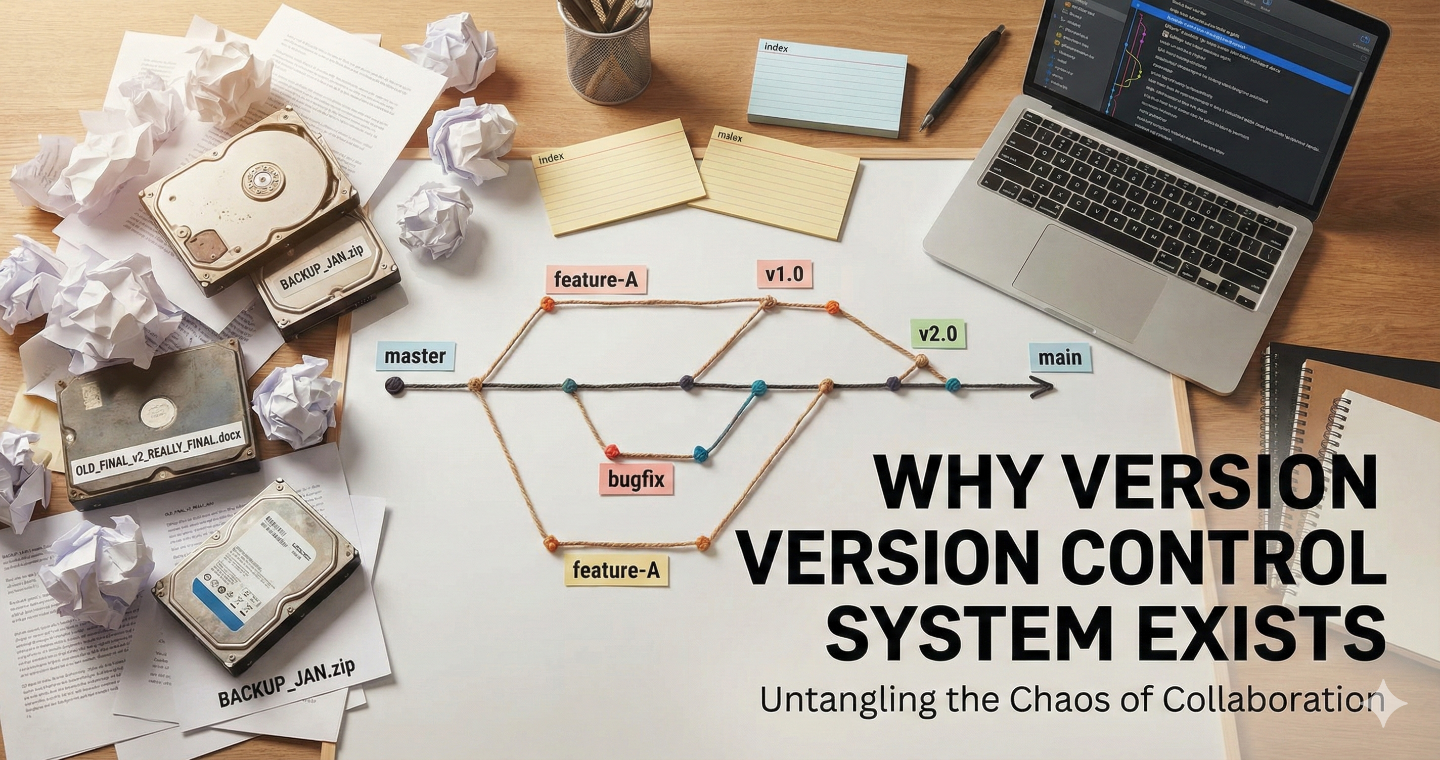
If you’ve ever worked on a group project, you know the "Final Version" struggle. You save a file as Project_Final.docx, then your friend edits it and saves it as Project_Final_v2.docx, and before you know it, you’re looking at Project_Final_ACTUALLY_FINAL_USE_THIS_ONE_v3.docx.
In the world of software development, this chaos is exactly why Version Control Systems (VCS) were created. They are the "Time Machines" of the digital world, allowing developers to track every single change made to a project.
Why Version Control Exists
At its core, version control is about safety and organization. When building software, you aren’t just writing one file; you’re managing thousands of lines of code across hundreds of files.
Without a system to track who changed what and when, everything would fall apart the moment two people tried to work on the same thing. Version control exists to:
Keep a History: It records every change made to the code.
Enable Reversals: If you make a mistake and break the website, you can "undo" it with one click.
Allow Branching: You can test a "wild idea" in a separate space without ruining the main, working version of your app.
The Pendrive Analogy: What would happen if we collaborate using pendrives?
Imagine you and three friends are building a website. Since you don't have version control, you decide to pass around a pendrive (USB stick) to share your progress.
The Bottleneck: Only one person can have the pendrive at a time. If Sarah is working on the "Home" page, you have to sit on your hands until she’s done and hands you the physical drive.
The Overwrite Disaster: Imagine Sarah gives the pendrive to Mike. Mike adds a "Contact" page. Meanwhile, you realize you have a copy of the old code on your laptop, so you fix a typo and save it to the pendrive. Boom. You just accidentally deleted Mike’s entire "Contact" page because your version didn't have his new work in it.
The Physical Risk: What if Mike loses the pendrive at a coffee shop? Your entire project—weeks of work—is gone forever.
In this scenario, collaboration isn't just slow; it’s dangerous.
Problems Faced Before Version Control Systems
Before VCS became the standard, developers faced "The Dark Ages" of coding. Here are the specific headaches they dealt with:
1. The "Merge Conflict" Nightmare
When two people edited the same file, they had to manually sit down and compare every single line of code to see which version was better. This process was incredibly slow and prone to human error.
2. No Accountability
If a bug suddenly appeared in the code on a Tuesday, there was no way to tell who wrote that specific line or why they wrote it. There was no "audit trail."
3. The "Fear of Breaking Things"
In the old days, developers were terrified of trying new features. If you tried something bold and it broke the whole system, you might not remember exactly what you changed to fix it. This killed innovation because everyone was too scared to touch the "working" code.
4. Storage Bloat
People used to copy and paste entire project folders just to have a backup.
Project_Backup_Jan1Project_Backup_Jan2Project_Backup_Final
This took up massive amounts of hard drive space and made it impossible to find anything.


